
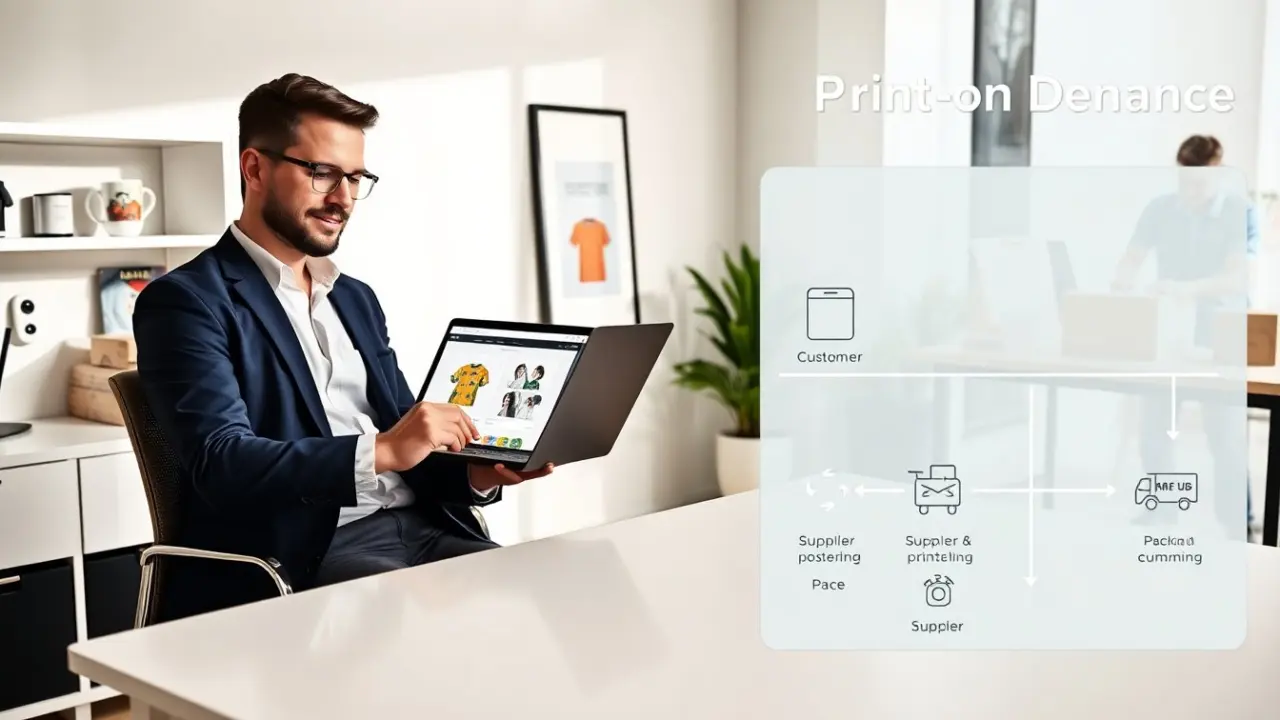
Print on demand definition appears here to explain the model clearly. The article defines print on demand and shows how it works. It states what customers buy and how sellers earn. It keeps language simple and direct for quick understanding.
Key Takeaways
- Print on demand means sellers create and sell products only after receiving customer orders, eliminating upfront inventory costs.
- The print on demand model allows sellers to test designs quickly and adapt to demand changes without storage concerns.
- Customers order products online, and suppliers handle printing, packaging, and shipping under the seller’s brand, keeping seller operations lean.
- Using print on demand reduces startup costs and supports global shipping, making it ideal for small businesses and niche markets.
- Drawbacks include higher per-item costs, longer delivery times, and reliance on supplier quality and reliability.
- Starting a print on demand store involves choosing a platform and supplier, uploading designs, setting prices, marketing products, and monitoring performance and supplier quality.
What Print On Demand Actually Means
Print on demand definition means a seller creates products only after a customer orders them. At its core, print on demand (POD) is an order-fulfillment model: instead of buying or storing finished items in advance, sellers supply artwork or designs and list finished items for sale. When an order arrives, a POD supplier produces the item (for example, printing artwork on a shirt, mug, poster, or phone case), packages it, and ships it directly to the customer. The seller controls branding, product descriptions, pricing, and customer service but delegates production and logistics.
This arrangement reduces financial risk because sellers do not tie up capital in inventory, and it makes it easy to test ideas and expand assortments quickly. POD is commonly used for apparel and accessories, but it also applies to print products like books, stationery, and fine art prints. The level of control a seller has over materials, print methods, and packaging depends on the supplier and service tier chosen.
How Print On Demand Works Step‑By‑Step
At a high level, the POD workflow follows several repeatable steps. First, a seller creates or sources a design and prepares product listings with images, sizing/format options, and descriptions. A customer then finds the product through the seller’s store, marketplace listing, or advertising and completes a purchase. The seller’s system or marketplace forwards the order and design file to the chosen POD supplier.
Next, the supplier produces the item according to the order specifications—this can involve direct-to-garment printing, heat transfer, sublimation, or digital printing depending on the product. After production, the supplier performs quality checks, packages the order (sometimes under the seller’s branding), and ships the package to the customer. The seller receives the retail payment, pays the supplier’s base cost and fulfillment fees, and keeps the margin. Throughout the process, the seller handles marketing, customer inquiries, returns, and any post-sale service, while the supplier focuses on manufacturing and logistics.
Practical touches to the workflow include preparing print-ready files with correct color profiles and resolution, setting realistic production and shipping lead times in listings, and establishing clear communication with suppliers about quality standards and fulfillment expectations.
Key Benefits Of Using Print On Demand
Print on demand lowers startup costs because sellers avoid purchasing inventory and renting storage. It enables a low-risk way to validate product ideas and run limited-time or seasonal collections without leftover stock. Because designs are produced only when ordered, sellers can offer a wide variety of SKUs—different colors, sizes, and designs—without the logistical burden of warehousing.
Other benefits include operational simplicity and scalability: sellers can focus on creative work, marketing, and customer relationships while suppliers handle manufacturing and shipping. POD also makes it easier to serve international customers through supplier networks that can produce and ship from regional facilities, often reducing cross-border shipping complexity. For creators and niche entrepreneurs, POD supports rapid iteration—testing variations of art or copy and learning from which listings convert best.
Common Drawbacks And Limitations To Consider
Despite the advantages, print on demand has important limitations. Unit costs are typically higher than bulk manufacturing, which can squeeze margins or require higher retail prices. Lead times are often longer than pre-stocked local retailers, so customers may experience slower delivery, especially for international shipments. This can affect conversion rates and increases the importance of transparent shipping estimates and proactive customer communication.
Quality variability is another concern: different suppliers, print methods, and product lines produce different results. Sellers must test samples and monitor returns or complaints to maintain brand reputation. Customization and packaging options can be limited, and fine-grained control over materials or ethical sourcing is sometimes constrained by supplier capabilities. Finally, because many sellers use the same POD services, marketplaces can be competitive on price and design—successful sellers rely on strong branding, superior listings, and targeted marketing to stand out.
How To Start A Print On Demand Store
To start a POD store, follow a clear sequence: choose a sales channel (your own website or a marketplace), research and select one or more reliable POD suppliers, and verify product quality by ordering samples. Prepare print-ready artwork with the correct file formats, color profiles, and dimensions required by the supplier. Create compelling product listings with multiple lifestyle and detail images, accurate descriptions, and transparent sizing and shipping information.
Next, set pricing that covers base costs, platform fees, marketing, and a sensible profit margin. Launch a small set of designs to test demand, and use low-cost marketing tactics—social posts, email lists, or targeted ads—to drive initial traffic. Track performance metrics such as conversion rate, return rate, and customer feedback, and be ready to switch suppliers or tweak designs if quality or delivery becomes an issue. Operationally, document processes for order monitoring, customer service, and financial recordkeeping so you can scale without losing control. Finally, iterate: use customer data to refine your catalog, expand best-sellers, and retire underperforming listings.